This post is meant to be nuanced, but as a writer I live in a world where I think it’s important make part of my position clear up front when it comes to AI. So I’ll start with a clear statement: I never use Generative AI for my writing unless there’s a specific reason to, and this article is the first and only time I’ve ever found a reason to use ChatGPT in my writing. It’s fine, you’ll see. (You can find more about the Myopic’s AI views here, if you’re curious)
So don’t worry, this isn’t some kind of pro-AI woowoo piece, but it’s also not totally a knee-jerk “AI is gross” piece. And it’s all my writing, for better or for worse (and yes, I love em-dashes and I refuse to let the machines take them from me), except the following list of quotes about the power and benefit of AI which actually seemed like a plausible use case for ChatGPT. For one, I don’t want to wade through all the bullshit spouted by tech founders, so outsourcing that kind of research to a bot seemed like a good idea. For another, I think it’s just a little more creepy to have AI tout its own values to the world through the mouths of the people who pushed it on us, as summarized by the tools they created to do the pushing.
To kick us off, below is ChatGPT’s list of quotes about how one of the favorite AI executive talking points of the past few years; the idea that AI is democratizing creativity. Note that I have not verified the accuracy of these quotes as I normally would, because the required reading to do so would simply annoy me too much. Plus if tech people are quoted inaccurately by their own tools, that irony must be preserved.
In the “words” of ChatGPT:
Here are 10 exact quotes from AI or tech founders/tech leaders focused specifically on creativity and how AI democratizes, empowers, or enhances creative expression (exact wording only, not paraphrases):
Sam Altman (OpenAI CEO): “Generative AI has the potential to democratize access to creative tools and empower people to express themselves in new and exciting ways.”
Sam Altman (OpenAI CEO): “Generative AI is not a replacement for human creativity, but rather a tool that can augment and enhance it.”
“AI doesn’t eliminate creativity—it democratizes it.” — Taryn Southern
“AI is the new medium for creative expression.” — Refik Anadol
“Artificial intelligence will amplify human creativity, not replace it.” — Ian Goodfellow
“Creative AI doesn’t replace artists—it gives them new superpowers.” — Sougwen Chung
“AI could create symphonies impossible for the human hand alone.” — Eric Whitacre
“AI can be the muse that sparks unfounded creativity.” — Daniel Ek
“Machines amplify the creative processes trusting human talents.” — Alex McDowell
“With AI, each creative path is a journey into unknown dimensions.” — Hans Zimmer
I think it’s fair to say these are all pretty biased sources (except maybe Hans Zimmer, the composer, whose presence on this list dismays me if it’s legitimate) who have a vested interest in telling us that AI is the future and we’d be fools to ignore it. But the trend, if we assume that ChatGPT used the most common, average, and basic examples of quotes available on the internet (which is pretty much what it’s built to do), is that the tech bros seem to believe they are doing something good for creativity.
In a word, they believe they are democratizing creativity by bringing access to it to everyone, and they clearly believe that’s a good thing.
There’s a lot to unpack there. What does it mean to democratize creativity? What does it mean to democratize anything? Is it a good or a bad thing to democratize creativity? I have some knee-jerk reactions to all of these questions, but when I thought about it in a little more detail, I realized there was actually more to the debate about how AI (specifically Generative AI) affects human creative pursuits, and how it relates to gatekeeping more generally.
Intuitively, I think every human with a pulse kind of knows using a computer to replace a human being in creative fields - writing, art, music, photography, what have you - is a pretty damn icky thing to do.
The counter to this (playing devil’s advocate, which I do often in this article), is that the act of creating technology that can do this stuff is, in itself, a pretty fulfilling creative act in itself that has captured the attention of thousands of brilliant technical minds. Imagine you were the Picasso of coding - what other challenge would be more appealing to you than creating a machine that can replicate human thought, creativity, or whatever? That sounds like the most fascinating creative challenge ever, if you accept coding as a creative act. The 5th quote in the list above is indicative of this: “AI is the new medium for creative expression.” - Refik Anadol. In what world is AI a medium for creative expression? A world where the “canvas” of your creation is in making a tool - AI - that supposedly mimics creation itself. AI is the great creative project of technical minds, and that allure must be why they seem so willing to run smack over all other forms of creativity.
That’s the ultimate irony of Generative AI to me; many smart people driven by the impulse of creativity are destroying the creativity of the rest of the world, in the name of democratizing it.
What is Democratization in this Context?
I’m gonna keep this short, but I think it’s important to dissect just a little.
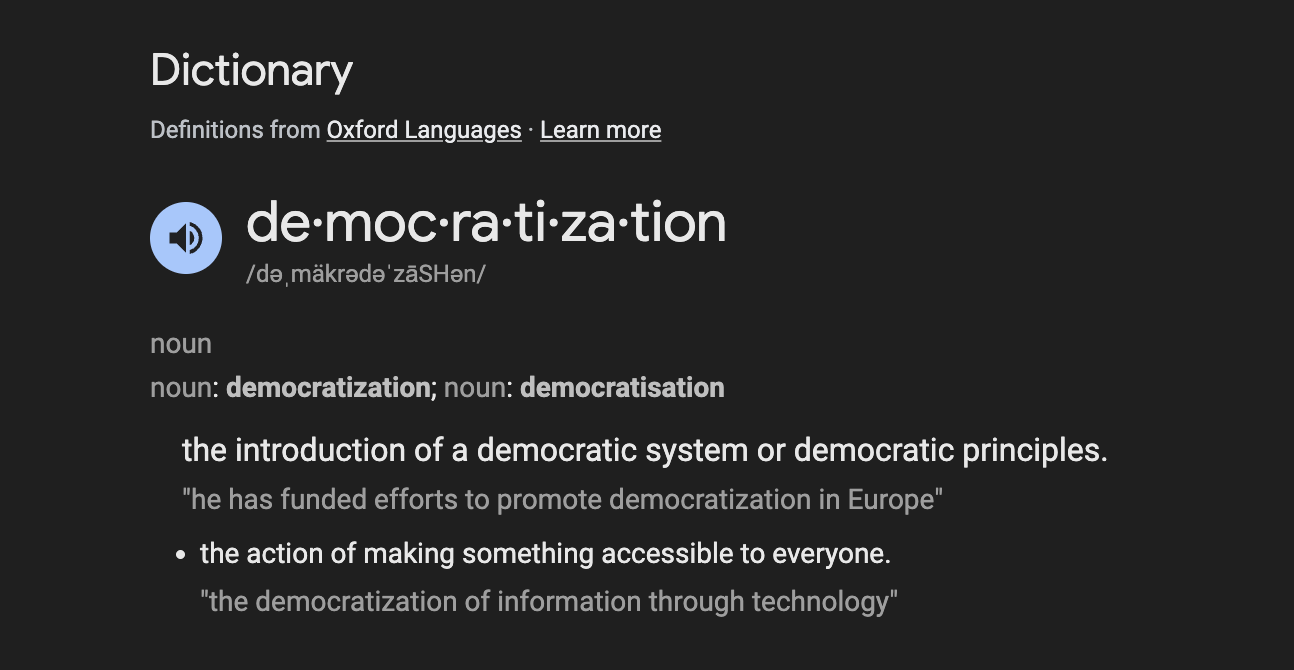 First page of Google’s search results, aka the word of the almighty
Pretty easy. So when AI proponents say their product is democratizing an industry, they presumably mean they’re bringing part of that industry to everyone. On the surface, it makes perfect sense.
The surface level argument of democratization being a good thing is, in fact, pretty easily defensible from a certain point of view. Think of any example of technological democratization in history, and tell me if you think each had a positive or negative effect on society’s creativity - the printing press for reading, radio or the vinyl record for music, the VCR for movies. In nearly every case, putting the means of consumption into the hands of the people has been an overwhelmingly good thing in breaking down barriers and gatekeepers.
“AI is the new medium for creative expression.” — Refik Anadol
—ChatGPT
You could say the same thing in many ways about putting the means of creation into the hands of the masses, and this is a key argument of the Generative AI pushers. The portable film camera must have by definition pushed photography to new heights (and into existence, really) as an art form. The affordable typewriter must have helped many new authors take the leap into writing. The ability to mass-print books on every creative subject imaginable must have caused the proliferation of millions of new artists learning and practicing their craft.
And today, you can even make the argument that the advent of tools that simultaneously promote creation and consumption by the masses, e.g. social media, has caused yet another exponential rise in the number of people creating things, whether by sharing their traditional creative pursuits or by using this new medium as an art form of its own (love it or hate it, an argument could be made that TikTok videos are, in fact, an art form).
There’s a pyramid effect that comes from democratization. In theory, if the bottom layer of the pyramid gets bigger (e.g. the amateurs, beginners, young people, etc. entering an art form), the top of the pyramid must get higher. More participants in an art form can only increase the value of those who are the best at that art form, or at least the quantity of those at the top, which amounts to the same thing. The highly talented part of the pie gets bigger, as they say.
All of these points could be (and are) used to point to the idea that Generative AI, as a means of enabling more people to create art and more art to be created, is simply another way of expanding the bottom of the pyramid, expanding the rosters in the minor leagues in order to produce more major leaguers one day.
But for many key reasons, I don’t believe that’s true of Generative AI.
Process-based and Product-based Democratization
Sam Altman (OpenAI CEO): “Generative AI is not a replacement for human creativity, but rather a tool that can augment and enhance it.”
—ChatGPT
My thesis boils down to this: innovations that enable a new product should be evaluated differently than innovations that enable a new process. New products or processes that are good for humanity (or remove products or processes that are bad for humanity) are good applications of an innovation, and vice versa.
So we have four corners of the square when it comes to innovations.
Create new product that’s good for humans - good!
Create new product that’s bad for humans - bad!
Create new process that’s good for humans / better for humans than old process - good!
Create new process that’s bad for humans / worse for humans than old process - bad!
For example, my gut feeling (presumably shared by others) is that the invention of the printing press was good for the arts of writing and reading. The printing press offered a cheap new way to print books - a new process. I’d also argue that cheaper and easier access to printed words also constitutes a new product, and that’s the more important half of this equation. The new process was probably on the whole good for humanity - it benefited humans by enabling more people to get their hands on books, which were presumably more scarce and expensive when they were handwritten, while on the negative side it probably put some scribes out of business. The new cheaper book product was probably good for humanity as well - more literacy is a positive in my book (pun intended). The printing press, put simply, enabled a new product and a new process to create that product, both of which were good for humans.
Let’s compare that to generative AI in the context of, say, reading and writing. The product created by generative AI - it’s “writing” - is, by all measures, a worse version of the previously existing product. And although the AI gurus promise this won’t always be the case, even if genAI does catch up to human writers (by being original without ripping them off) the end product is still by and large the same at best. So there’s no new product created by generative AI writing, which then leaves only the process angle. GenAI promises a new process for creating the same product. But is this good for humanity? My argument is a hard no, because this process takes away the act of writing (both by making the skill unnecessary and removing the incentive for new writers to emerge). The act of writing, of thinking and creating thoughts communicable to others, is inherently good for humans. This new process has removed an old process - thinking - that was good for us. What’s the benefit of that? To push out twice as many Powerpoints each day?
Generative AI writing tools create, at best, no new product, and replaces a good process with a worse one. In this framework, I truly don’t see the point of the tool itself, although as I mentioned before, I can see the fun in the creative effort required to create such a tool. But that’s not enough to make it right.
But let’s play devil’s advocate for a minute. I’ve often thought about ways AI could actually be used to improve bad processes in creative work. What photographer hasn’t dreamt of an AI assistant to keep tens of thousands of photographs in order on a hard drive, for example? Or to handle the initial sorting and rating of photos faster than I can? Or uploading finished photos to stock websites or clients? Your needs and solutions may vary, but the point is these are all easily fixable things that don’t corrupt the art itself, and therefore are at least more defensible from a creative perspective.
My answer to this is that yes, all of these solutions can and probably will be created, but they’ll never be the end game. The problem is similar to my earlier theory about the creative satisfaction of the coders creating genAI - it’s less fun (and less lucrative) to create simpler, practical, made-for-purpose solutions. Much more fun for the programmer’s creative soul and the CEO’s ego to promise world-changing technology, as if the entire world itself is the problem.
Democratization vs. Gatekeeping
“AI doesn’t eliminate creativity—it democratizes it.” — Taryn Southern
—ChatGPT
I hate gatekeeping as a general rule. Nothing annoys me more than an old grizzled “expert” telling a beginner how much they suck at something. Why do experts forget they were once beginners? It drives me crazy, and worse it just seems to be part of human nature to exclude groups you see as beneath you even if you were once a part of that very group.
But a key effect, or perhaps the central effect, of democratization in its idealistic form is the downfall of gatekeepers. To hear the AI gurus talk about it, generative AI will cause a widespread creative revolution where everyone can suddenly be a world-class artist or songwriter or writer. They never really say what “world-class” means in this context.
I’ve been really into photography for a few years now, and it’s a hotbed of gatekeeping activity. There are very few places on the internet who can make a beginner feel small faster than r/photography and its kin (except maybe r/writing). God help you if you post the first photo you took with your beat up old camera, the first one you’re proud of, and it’s not professional grade right off the bat. What’s the key to success, you ask? “Just buy a Sony A1, bro”
Photography is also an occupation/hobby that’s been heavily affected by the rise of social media and AI, and nearly all in a negative way.
Sure, now it doesn’t take a professional with a zoom lens to create a pixel-perfect social media-quality image of a lion, thanks to genAI tools. And even for the responsible pro-human photographer, it’s hard to ignore the temptation of using Lightroom’s AI Denoise feature to make every low-light photo look like you knew what you were doing.
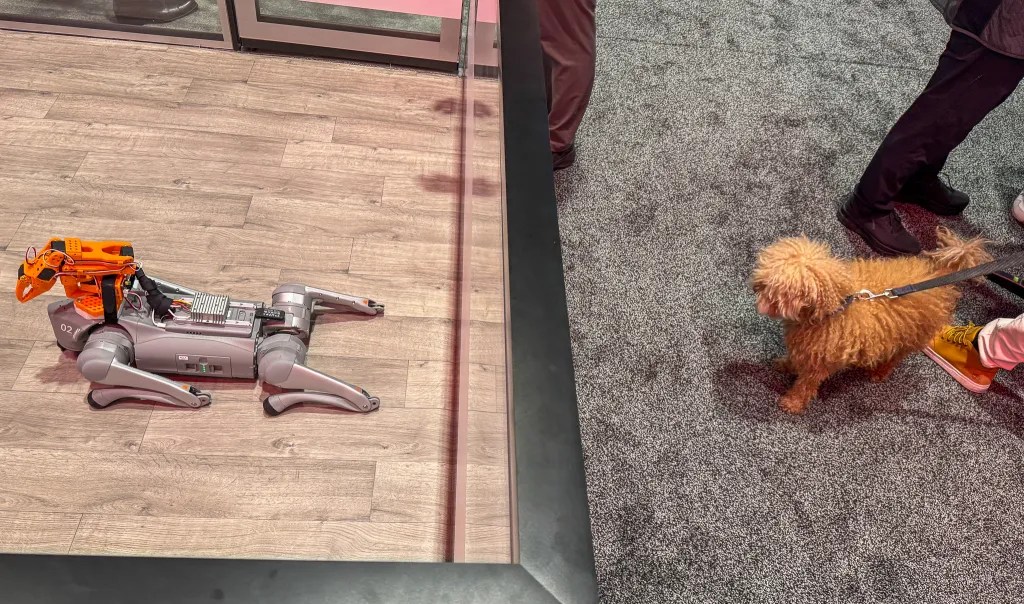 “I’ve been Dogging the hard way my whole live and now they can just teach a computer to Dog?!?”
But is that what democratization means? Is the instant access to perfection really how the act of gatekeeping dies? In my experience, the gatekeepers of r/photography now gatekeep even harder with lines like “this must be AI”. And even worse, now their gatekeeping is arguably the right thing to do. The only photos that make it past the mods’ anti-AI scrutiny are those from known names, or those that are so bad they must have been taken by a human. The entire middle class of photos is marred by the mere possibility that the images were not produced by humans. Is that really the objective of democratizing creativity? To leave nothing but the terrible and the great human art, with nothing between?
I guess I need to wrap this up.
In the end, generative AI is going to have an effect on the creative world, a mix of good and bad. Duh. And it’ll likely be more bad than good, in my opinion, also duh.
But let’s call it what it is. Generative AI is not democratizing anything. It’s socialism.
Socialism isn’t a bad thing, of course, but I’d pay good money to see the tech industry stand next to their newfound conservative allies and tell the truth - that their products are turning the world of human thought into a giant socialist regime, a world where the “free market” of competence-based creativity is eradicated in favor of a grey, bland, unvarying echo chamber of the hallucinations of a machine.