

The idea that the future is guaranteed to be a dystopian hellscape has always seemed silly to me.
Every generation thinks the same thing; that the one directly following them will ruin the world. The changes the young kids are making are just too much for our societal fabric to handle. They’re going to morally or literally destroy the beautiful society we’ve worked so hard to build, the one that was so much better back in the good old days when we grew up.
I’ll simplify this by referring only to my own Millennial generation, but keep that point in the back of your mind; you can substitute your own generation, now and in the future, for mine and the story will be largely the same.
 I made the mistake of searching “vintage” in my photos app and this came up. I don’t have any of these GBA games anymore but man these were some good ones. Just to establish my Millennial bona fides
The first logical fallacy here is the idea that the society that Millennials are nostalgic for is actually one that we built. Have you ever asked a Millennial their favorit movie or music? They’ll invariably quote something from the 90’s or early 2000’s, which is when most of us were between 10 and 15, give or take. 10 to 15 year olds can barely get themselves to school on time - they had nothing to do with building the society they love so much. That honor belongs to the generation before, and although they were undoubtedly targeting Millennials with their marketing, Millennials taking credit for the society they grew up in is pretty absurd.
And according to our earlier point, it’s a certainty that the generation before Millennials, Gen X, widely believed that the Millennials were ruining society. See the problem? The society that caused this pessimism wasn’t even created by the Millennials, but they’re blamed for it. This cycle probably repeats in every set of successive generations in history. Even today, you’ll hear Millennials complain about Gen Z, about how they use words like “bet” and “bro” and “rizz” and God knows what else in every sentence. Guess what? Every one of those words can be found in the 90’s rap that my fellow Millennials and I love so much. We created the monsters that we complain about, just as Gen X created the “broke Millennials” that they complain about so much, just as Millennials and our obsession with tech created the “terminally online” Gen Z’ers we like to make fun of. Does that seem fair to anyone?
I know I’ve made a lot of gross generalizations here that an educated sociologist could probably tear apart. But the main point is this: every generation thinks the next one will end the world, and every generation has been completely wrong so far. So why would today be any different?
Sure, you can cry “AI” or “Global Warming” or “Nuclear War” or whatever else you might be worried will end the world. Are these all legitimate threats to humanity? Yes, of course they are. But humans tend to look at things in black and white. That means that when we imagine the impacts of clmate change, we imagine 2 scenarios: 1 where we’ve saved the world and we live in a green energy utopia, and 1 where the sun has turned red and we wear gas masks as we trudge across the Mars-like landscape where every form of life has been burned to a crisp.
That brings me to my next issue with pessimism about the future: people are unable to think statistically, becuase that’s just not how we’re wired. It’s simply not that intuitive to consider a range of outcomes that each have a given likelihood - we focus on the best and/or worst outcomes, by and large, and that leads us to think that these outcomes are equally likely.
If you’ve ever taken a statistics class, you know that these extreme outcomes - the “long tail” or outliers, good or bad - are by definition extremely unlikely. There are a million intermediate outcomes that, all together, form a distribution of potential results, and the middle range is far more likely than any extreme - for example, a world where some plant species have died, but where we’ve got climate change under control and haven’t caused a worldwide mass extinction event, is far more likely than the literal end of the planet. It’s not as exciting to cover these scenarios on the news, of course, but in reality something along those lines is most likely to happen - the level of global warming might vary, and the level of impact on the plant and animal species might be more or less in the actual end scenario, but that range of events will most likely not include everything burning up in an Earth-sized pressure cooker.
You can extend that thought to all of the doomsday scenarios that are out there. What’s more likely - that AI will rise up and end the world, or that it will become a useful part of our everyday lives in a regulated way? Is it more likely that TikTok is going to destroy our youth’s attention spans and leave us with a society of drooling, scrolling morons who have never touched grass, or will we start to regulate - privately or publicly - the way we relate with social media and find a way to coexist with it?
I realize that predicting the middle ground isn’t exactly a hot take, but that’s the entire point. Hot takes are for shameless eyeball-seekers, not for realists. And my point here is that even the most middle-of-the-road realist, once they start thinking statistically, has to admit that the situation in the world isn’t as dire as our headline writers seem to think. Optimists like me, therefore, have no excuse to think the world is statistically likely to end just because of a few new threats. Or at least, we have no reason to think it’s that much MORE likely to end today than it was in the past.
There’s one intuitive counter-argument that I’d like to address. If math bores you, click here to skip it:
An example: say we think there’s a 1% chance that someone will launch a nuclear warhead, starting a worldwide conflict. That 1%, we think, is the same every year. A freshman Statistics student would tell you that means that over 100 years, the chance of nuclear war happening is 100 x 1%, which equals 100%. So, they would conclude, the world is guaranteed to end in the next 100 years.
That feels intuitive, but it’s not the whole story.
First, let’s ask our freshman statistics student the odds of war in 200 years. “200%,” they would confidently tell us. That should be our first clue that something’s not right with that approach.
Mathematically, in the above example, the chance that the warhead scenario happens in the next 100 years is not 100%. In reality, we have to calculate the odds of the warhead scenario NOT happening in the next 100 years. That equals a 99% chance of no warheads over 100 years - that’s .99 x .99 and so on, 100 times - in other words, .99^100, which equals about .37, or 37%. That means the chances of nuclear war in the next 100 years would be 100% - 37%, or 63%. That number is still high, but it’s not a 100% certainty, and that’s the point.
Also, the odds of nuclear war in the next year are almost certainly less than 1%. If we assume a 0.1% chance of war each year, the odds of nuclear war happening in the next 100 years goes down to 9.4%. If we use 0.05%, then the odds of war in 100 years go down to 4.9%. Now we’re getting a little more realistic.
The takeaway is that the odds of rare things happening - good or bad - always seem higher in our minds than they actually are. If you need further evidence, take the lottery as an example. People can’t fathom how low their odds are of winning, so they buy tickets anyway. Or look at influencer culture - every kid thinks they can become a Mr. Beast because the only influencers they see are the successful ones, not the millions who tried and failed. Those outliers of success take on a larger than life possibility in our minds because of the false intuition I mentioned above.
That’s not to say you shouldn’t try to do things that have long odds - the point is only that the middle ground is by far the most likely outcome.
So whether you read the statistical part or not, at this point we’re all pretty convinced that the most likely outcome is the middle ground.
So where is the actual middle ground I mention above? Well, it depends, but it helps to visualize, so I’ve scribbled some nice charts for us to look at as we build our optimism together.
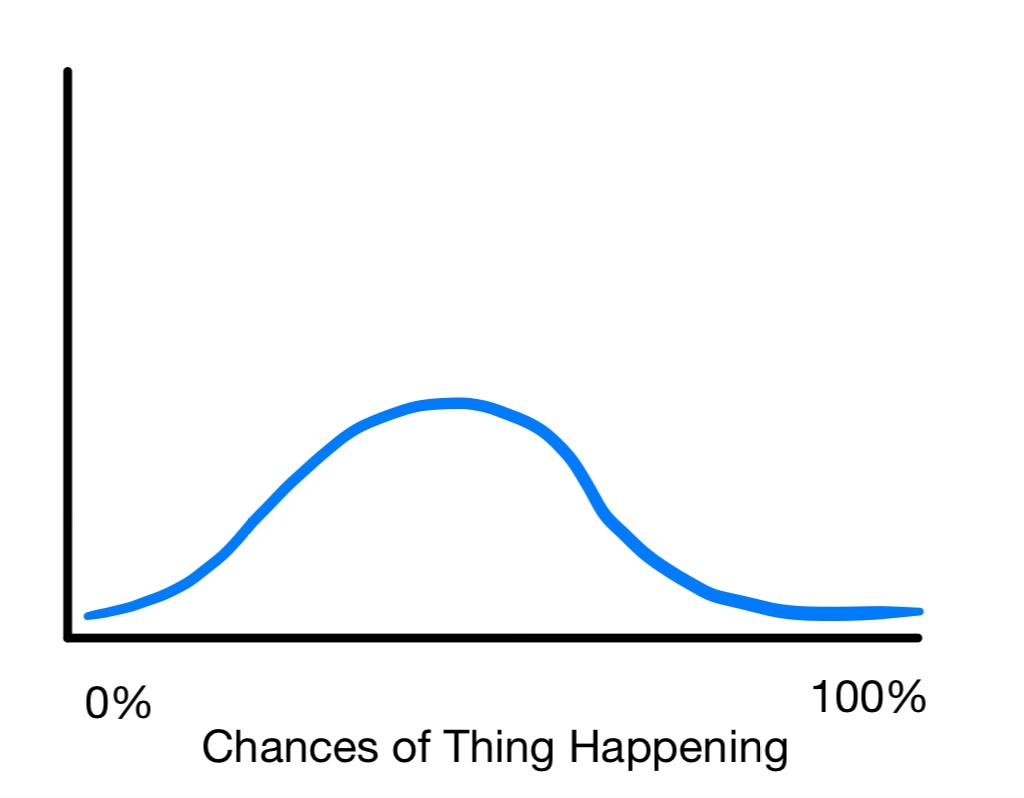
First, there’s one more boring concept we have to introduce - the Central Limit Theorem. This basically states that over a long period of time, the distribution of outcomes tends to become normally distributed - aka the curve below, where the average outcome is most likely and extreme outcomes are less likely.
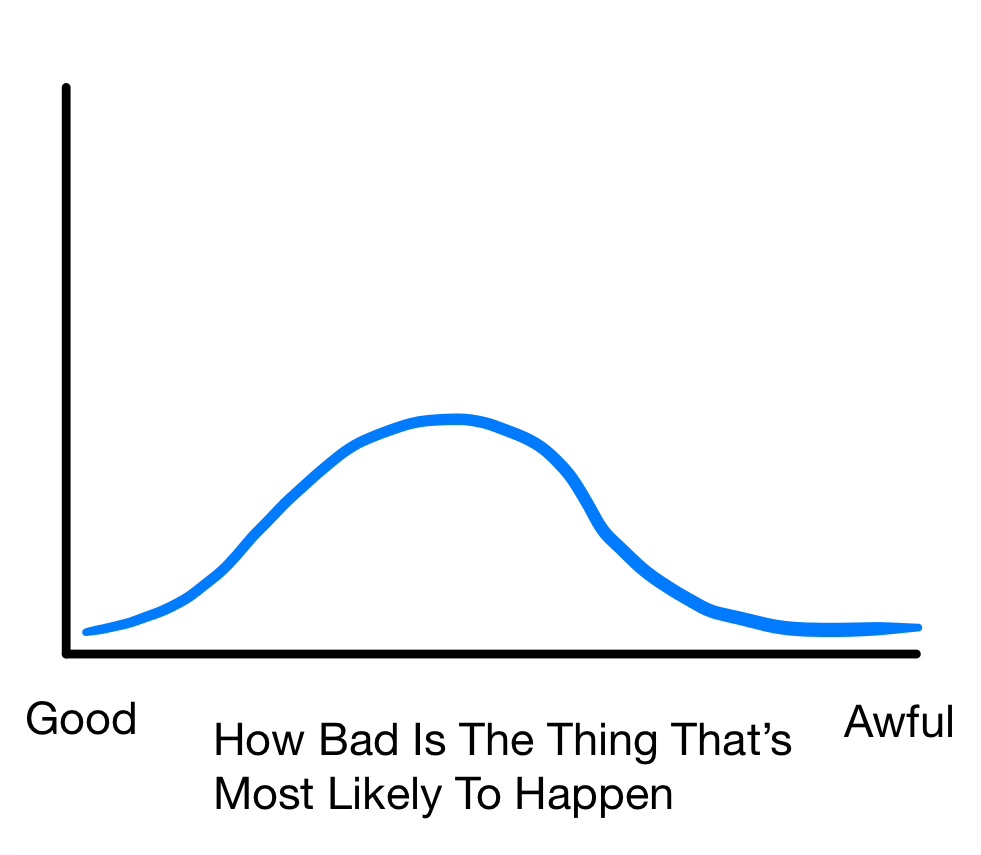
This is what really happens in life, time after time - the thing that actually happens is most likely in the middle of this curve.
In contrast, this curve is what I think many of us hold intuitively in our minds:
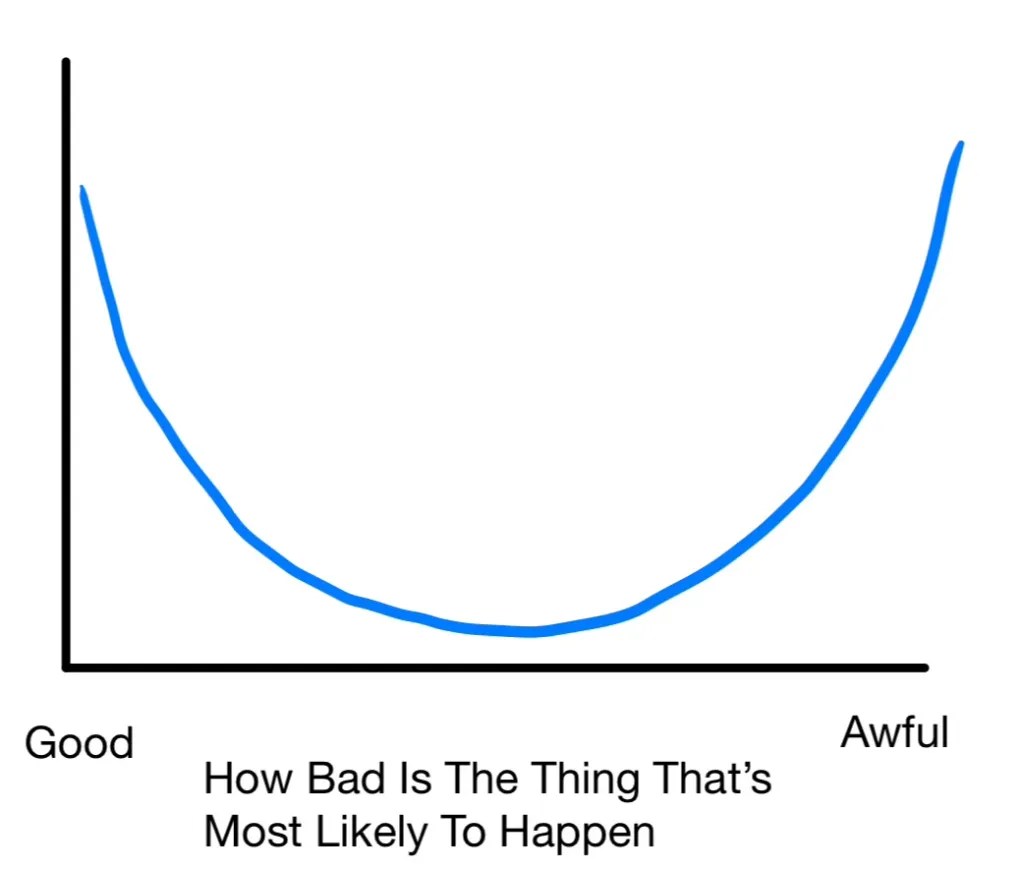
We like to focus on the super good and super bad outcomes of anything. That’s humanity. And honestly, the “Awful” outcome side of this curve should probably be higher than the “Good” side, but I couldn’t make my over-optimistic self actually do it that way.
You can even put it another way. Nobody knows the likelihood of anything - our perception of the likelihood of events is mostly subjective, and each of us has a separate opinion. Here are our familiar curves again, but this time they show what each of us thinks are the odds of some extreme event happening - you can use our example from before of nuclear war, if you like. How likely do you think that event is to happen in the next few years? The “smiley face” chart is how it feels to me.
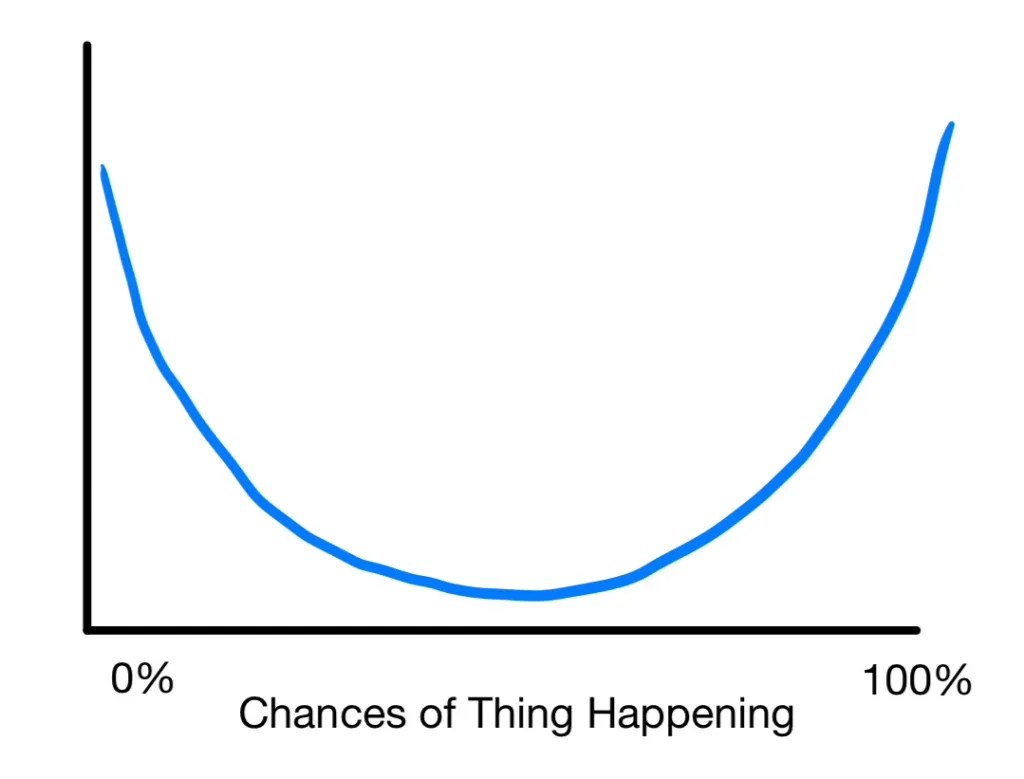
Everybody either thinks it’ll never happen, or that it’ll happen without a doubt. This can apply to good or bad events, in my mind, as long as they’re relatively unlikely - people will, consciously or subconsciously, form their opinions like the curve above, when in reality the outcomes will be according to the curve below.
Of course, this chart looks different for every event. Some could look like this, for example:
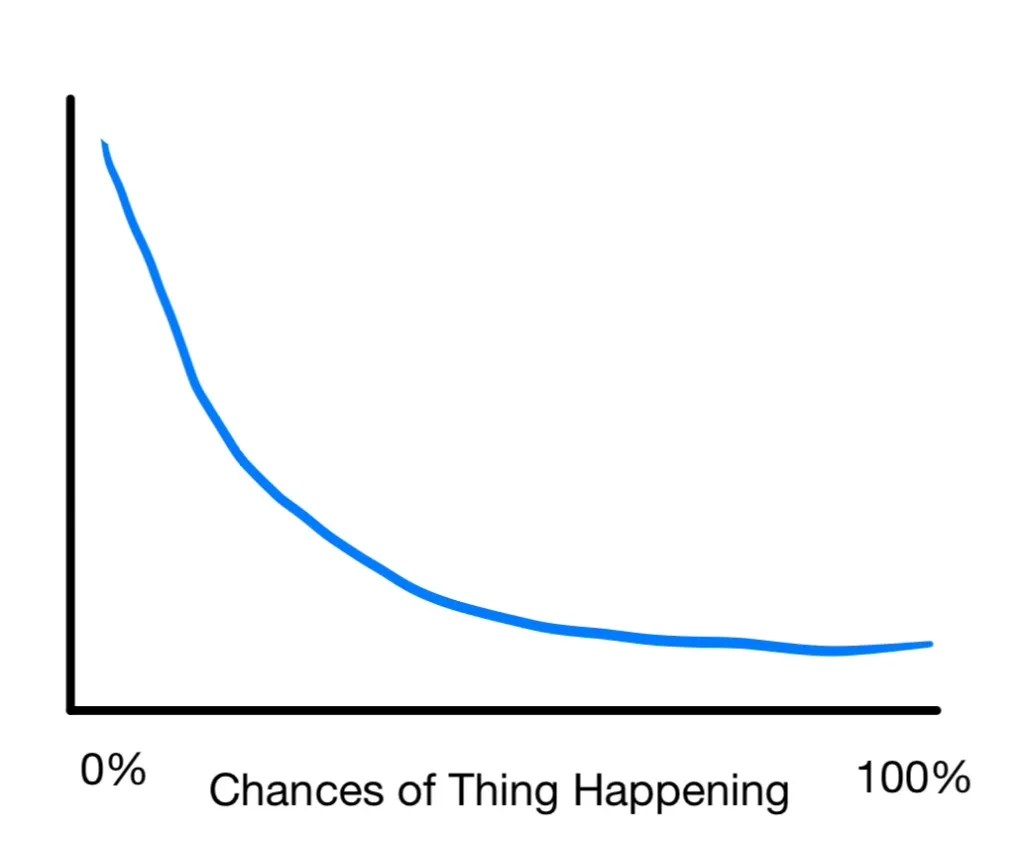
In this example, most people think the thing will never happen, and some think it’s very likely. In reality, the answer is still somewhere in the middle, but perhaps closer to the left side of the graph than before. Every event is different. But the point is that the “Smiley Face” chart is by far the least likely to be accurate, since it assumes the lowest probability outcomes are the most likely to happen. Yet that’s what popular media seems to have ingrained in our minds. I won’t get into why that might be, but it’s a trend we should all be aware of.
——
So how is all this supposed to make you an optimist?
I guess that depends on where you currently stand on the spectrum of “the world sucks” to “utopia is right around the corner.” I’m not actually saying that bad things aren’t going to happen. My point is that you should really dig into your gut feelings before you make up your mind about how optimistic, or pessimistic, to be about a given situation.
All humans have logical errors in their thinking, and that’s perfectly fine. The goal isn’t to avoid gut feelings or emotional decision making - both of these things can be great in the right setting - the goal is to increase our awareness of what factors enter our thinking. This will allow us to ignore or promote certain aspects of our thinking - for example, when we see news stories that take extreme positions about the impacts of climate change, we can step back and realize that the real most likely outcome is somewhere in the middle, regardless of our personal feelings on the subject. The chance that climate change is going to have no impact on the world is essentially zero, and the chance that the world is going to melt from climate change is essentially zero. The real answer is somewhere in the middle - yet we only hear about the two extremes.
So going back to our initial question - is the next generation going to destroy the world? What do you think when you put yourself in a “middle ground” frame of mind?
Ignoring the extremes and intuitively knowing that the real answer is somewhere in the middle is a useful but vanishing skill. But if you want to have a view of the world that might be closer to the truth, it pays to consider the middle-of-the-road outcome more often than not.
The middle ground might not pay in “attention dollars”, but if that’s what you’re after, your soul is already beyond my help anyway.