Not only am I a massive music fan, I’m also a massive musical instrument fan. My love of guitars goes as far back as I can remember, when I first saw my guitar teacher’s red Stratocaster at age 7 and couldn’t understand why I couldn’t just play that guitar instead of the beginner acoustic I was learning on.
What started as a fascination with playing electric guitars grew into a fascination with modifying them - replacing components soon morphed into modifying the electronics, meddling with the innards of every guitar I could find to understand how they worked. Those skills, as you’ll soon see, came in very handy when I came across a super rare guitar that was in desperate need of a rebuild.
This is a really cool story, and I hope you’ll enjoy it. And as an added bonus, I’m not talking about a Stratocaster or Les Paul, the darlings of the popular guitar rock world - I’m talking about a cool guitar model many people might not have heard of: The Fender Jaguar.
To start us off, though, I thought it would be fun to get into the Jaguar spirit with a playlist of songs featuring the guitar and its signature sound.
Jaguar Jams
Arguably the most famous user of the Jaguar was Kurt Cobain. But there have been others - John Frusciante, Johnny Marr, and a whole list of more recent artists who have embraced the Jaguar’s unusual sound. I’ve rounded up a few of the songs here to give you a taste. When you listen, take note of the fairly “twangy” or “beachy” tone on the guitar. It’s kind of thin and stringy to me; that’s a hallmark of the Jaguar and a reason many artists loved and hated it.https://open.spotify.com/embed/playlist/1G4bdJB9FoWsWOC68Go7mT
About the Fender Jaguar
I won’t try to rewrite the history of the Fender Jaguar; this link (and this one) sum it up so well that I don’t think I’ll attempt it. But I recommend you check out the history of the Jaguar. It’s a cool story - the Jag was intended as a flagship guitar, but around the time it came out the rock and roll sound we know today was developing, which was all about sustain - as in how long the notes could sound after being plucked. This is what led to the massive guitar hero solos of popular classic rock, and this sound was just something the Jaguar wasn’t very good at. It makes a kind of twangy sound that fades fast, very unique but not the stuff of epic arena guitar solos.
As far as popular rock guitar models go, most people know about the Stratocaster and the Les Paul, the Flying V and the SG, and even the Telecaster for folks who enjoy the twangier side. There’s also the Jazzmaster, which is frequently confused with the Jaguar due to its greater popularity and similar shape. But the Jaguar was a bit unique, not really fitting into the Gibson and Fender dominated guitar scene
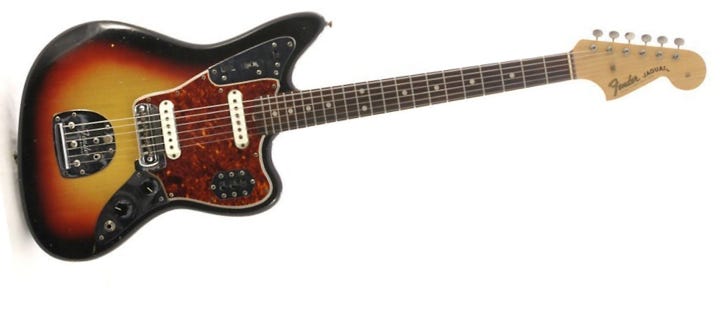 The original Jaguar (image: Reverb.com)
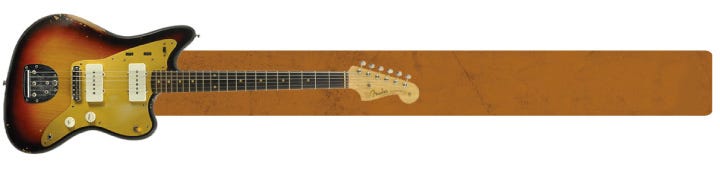 The Jaguar’s cousin: the Jazzmaster (Image: Reverb.com)
The Jazzmaster is simpler, without all the chrome pieces, and had already gained popularity by the time the Jaguar came out. It’s the more popular of the two guitars for many reasons, but as you’ll soon see, I didn’t much care about the popularity of the Jag when starting this rebuild.
The Story Of My 1962 Jaguar
The story of this guitar starts with my childhood guitar teacher. He was a great family friend who sadly passed away several years ago. All through my childhood he would come to my parents’ house every Sunday for a guitar lesson and a plate or three of my mom’s spaghetti. He was an awesome and entertaining guy, played in several local bands, and taught me to pluck out the tune of Rocky Top as a funny prank on my family (Rocky Top is the fight song for the University of Tennessee, and my family was largely supporters of a rival school who couldn’t stand the song for that reason. That’s the South for you!).
When he passed away, he left me all of his music equipment. I can’t tell you how touching that was for me - he had plenty of other guitar students and family members, but thanks to his friendship with my family he thought of me when passing along his guitar collection. Maybe I’ll go into that more later, but for now, let’s stick with the story of the Jag.
A few years after his passing, my dad and I got a request to look through his house before it went for sale - specifically, to go through his old shed in the backyard that had never been cleaned out. So we got our boots and gloves on and dove into the mess.
Halfway through the cleanup, we discovered the body of a guitar. It was just the wooden part with no electronics, chrome covers, or neck, and it had been spray painted blue (poorly). There was a little splinter of the neck still attached where it had seemingly been broken off, but most importantly, the neck plate was still attached.
We didn’t think much of it, but we took it home, thinking it might be a fun project to put it back together. But after some research, we identified something pretty cool. This was the body of a Fender Jaguar, and based on the way the electronics holes were drilled, it seemed to be a very early model. (There was an additional hole drilled in the first models of the Jaguar that was redesigned in later years). And the big kicker, the serial number on the neck plate confirmed our suspicions: this was one of the first Jaguars ever made, serial number 78503 from 1962, the first year Jaguars were produced.
The next day we went back to the shed to search for the other missing pieces of the Jaguar. Sure enough, we found most of them; the tremolo/bridge, some tuning pegs, pickups, and 2 of the 3 metal plates that adorn the front of the Jaguar.
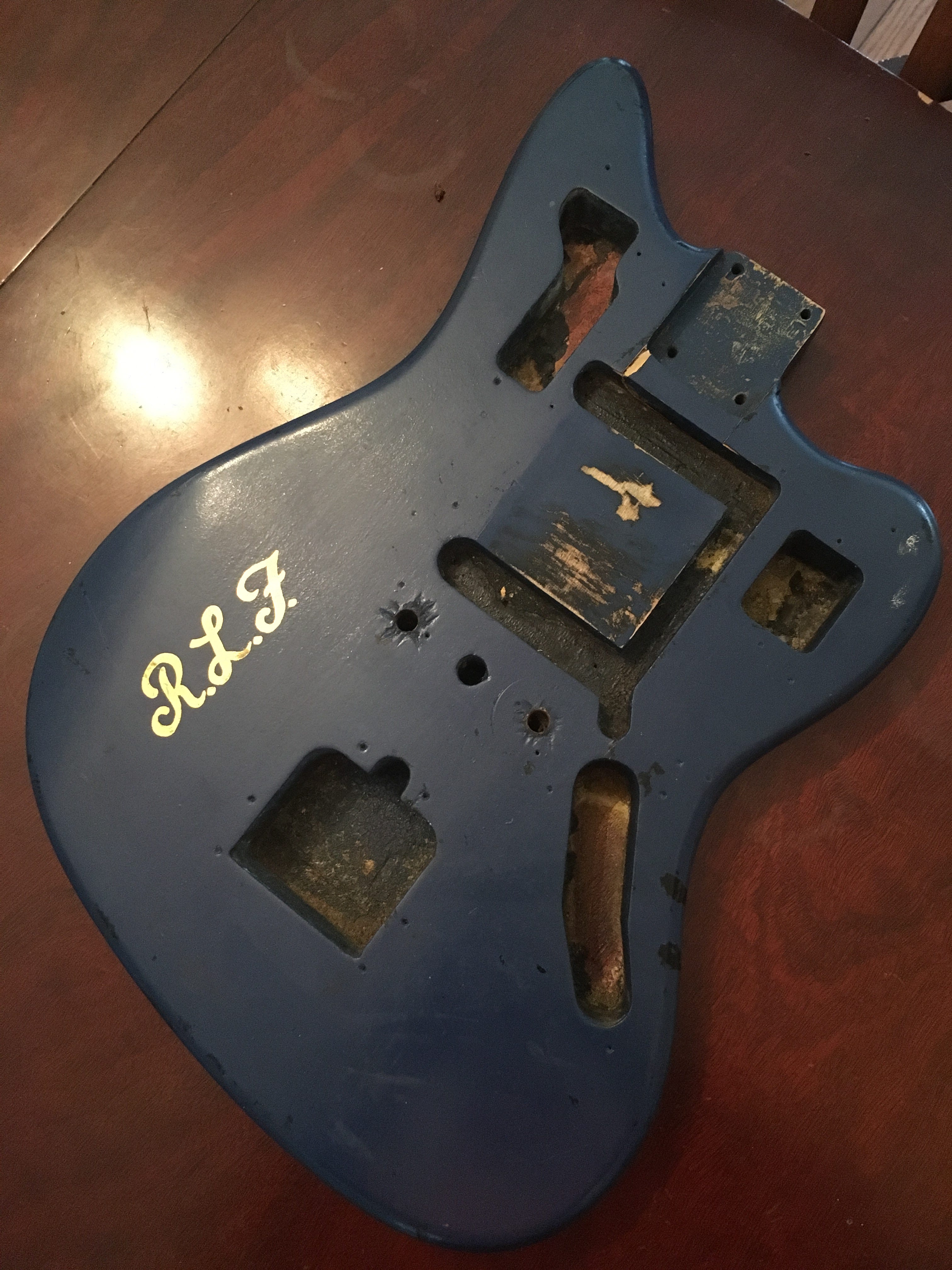 Front of the 1962 Fender Jaguar. I did some light sanding to see if there was any clue about the paint color underneath the spray paint. You can see the black paint that hints at the original sunburst color, but I didn’t put 2 and 2 together at the time.
 Back of the Jaguar. There was some personal info scratched into the neck plate that I scribbled out - bummer, because the neckplate alone would have been worth hundreds without the markings if I ever wanted to sell it!
 The original Bridge / Tremolo piece. Another pretty rare find that sells for hundreds in the wild
And thus, the Great Jaguar Rebuild Project was born. Because of course we had to rebuild this thing.
I thought a lot about why we found this guitar in this condition, and we eventually landed on a theory.
The Jaguar, by many accounts, was actually considered a crappy guitar in its early years. It had complicated electronics that failed a lot, and it didn’t sound different enough from its big brother the Jazzmaster that people cared about it - it actually had poor sustain and was prone to go out of tune from its unique bridge design. I think that’s why we found this guitar in this condition - one theory is that my instructor took his least favorite guitar and spray painted it Red, White and Blue for a 4th of July concert, or something like that. You can barely see it in the pictures, but the neck splinter we found was painted bright red. Hell, he might even have smashed the guitar onstage for some reason. Rocking too hard, perhaps. We’ll never know.
You might have noticed the engraved text on the back plate - for some bizarre reason, the owner’s address and social security number are scribed into the metal. I have no explanation, but I find it strangely hilarious in today’s age of information security.
After a couple of weeks of investigation, we ended up finding even more original components. Unfortunately, the pickups and switches were too corroded to be usable, but the chrome pieces from the original guitar were mostly there. I think the yellow stains are from the old clear paint coat from the original guitar, but it’s hard to say. Could just as easily be beer stains.
 The original tone adjustment knobs and “rhythm/lead” switch unique to the Jaguar, still attached to the faceplate
But before we could get into the rewiring of the guitar, the next challenge was to get it painted. We found a great paint shop, which is sadly out of business now, but still had to decide what color to make the guitar. My dad and I searched for photos of the original guitar, but neither of us, nor my old instructor’s family, had any memory of seeing it before. I did my best to sand down the blue spray paint to find the original color of the guitar, but unfortunately there were very few clues to be found (at least, we didn’t put it together at the time). I guess the guitar’s original finish was sanded down before its backyard repaint job, which is a shame. So I hit the internet to figure out what colors were possible.
The original colors were the classic Fender 3-color sunburst, Lake Placid Blue, and Olympic White. There were also some custom colors available, but given the treatment of this guitar, I assumed it wasn’t a custom job. The neck also might have provided a clue if we could have found it - all of these guitars had rosewood fretboards over maple necks, but may also had a headstock painted to match the body’s color. Unfortunately, even after weeks of searching, we never found another sign of the neck.
So after some discussion, we decided to get the guitar painted Lake Placid Blue, like the beautiful example below. This was mostly a matter of preference, but we also thought maybe my instructor wanted the guitar to be blue anyway, given his choice of spray paint color. We also didn’t think the Sunburst would look as good on the old wood, and we were worried that the old blue spray paint would show through the clear sunburst. That actually wasn’t a valid worry, looking back, but we didn’t know any better at the time, so we stuck with blue. Plus, how awesome does that color look?
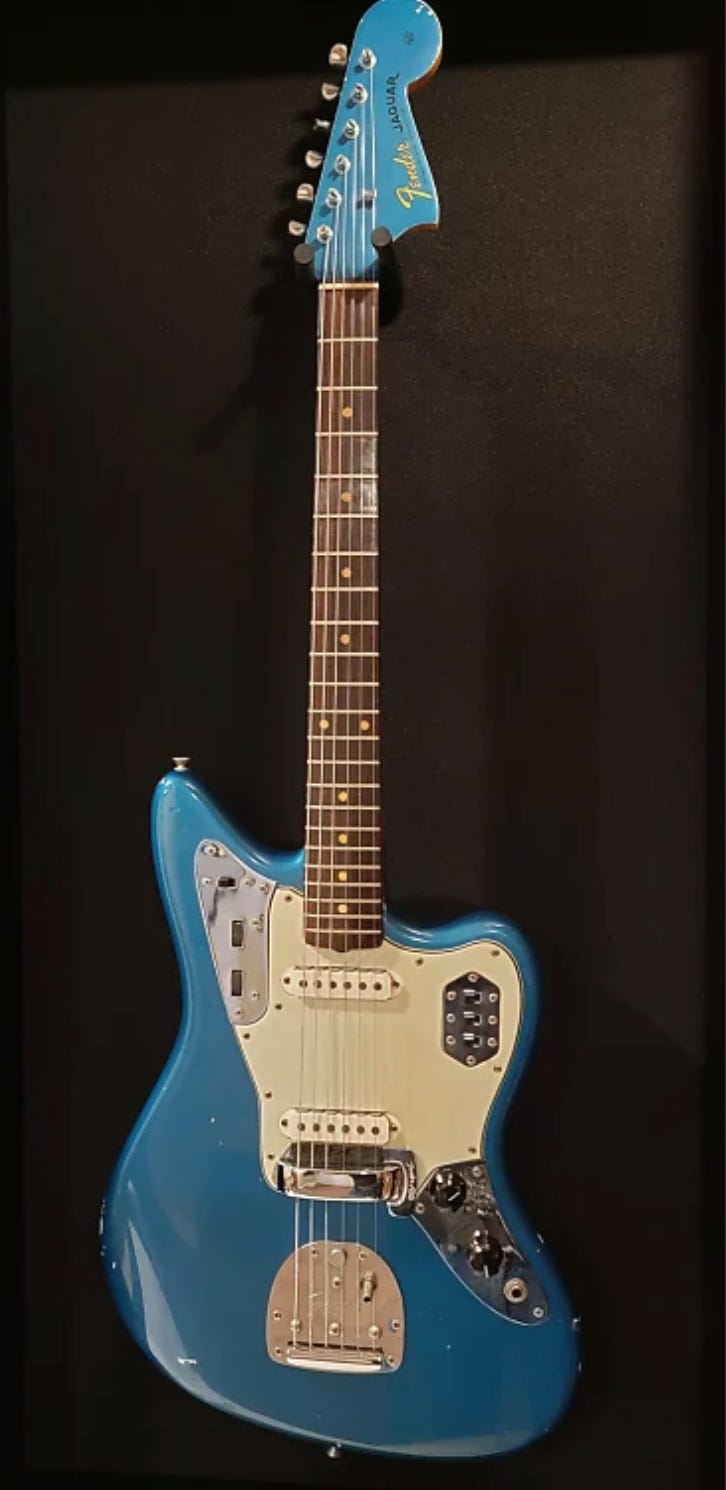 An original 1962 Fender Jaguar in blue. Image: Reverb.com
The only caveat, which we went back and forth about, was that the neck wasn’t going to match the body color. Not all Jaguars had matching headstocks - but the majority of the really high-end vintage guitars you see now from 1962 have the matching headstock. I just didn’t see a way to get it done in a professional (or affordable) way.
So we decided to get a new neck without a painted headstock, which was a 1962 replica made for the guitar’s 50th anniversary.
It was actually during the sanding and painting process that we got some more clues about the guitar’s origins. Below are some photos from the paint shop where we sent the guitar, which show some markings presumably from the factory:
They also discovered some nail marks under the paint that would have been used for drying or applying the paint in the factory at the time. According to the paint shop, this further confirms the body’s authenticity, although there wasn’t really any doubt at this point thanks to the neck plate. This body was from a 1962 Fender Jaguar.

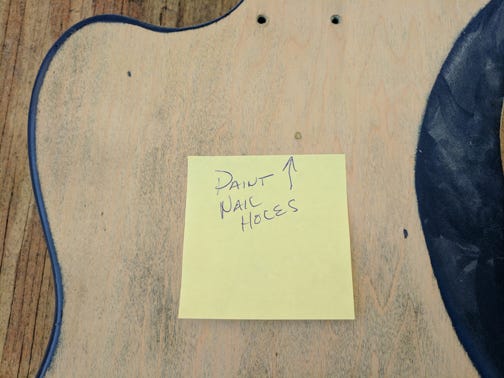
Now, you might have noticed something in these pictures that I didn’t notice at the time - the yellow paint coating the pockets. Put a pin in that for now - at the time we didn’t think anything of it, thinking that the yellow paint must have just been a primer sprayed on at the factory or something like that.
So we stuck with Lake Placid Blue, and a few weeks later, we got the body back looking fantastic:

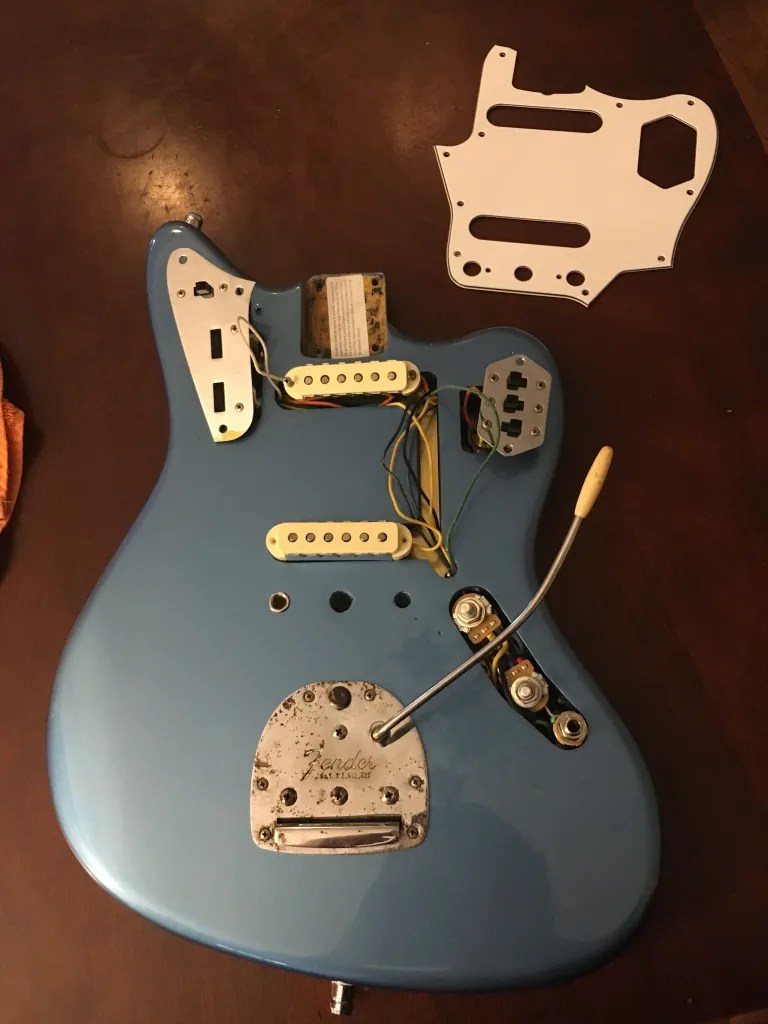
And of course, I had to lay out the chrome pieces and pick guard on the body to see how they were going to look:

Not too bad so far! But the hardest part was yet to come.
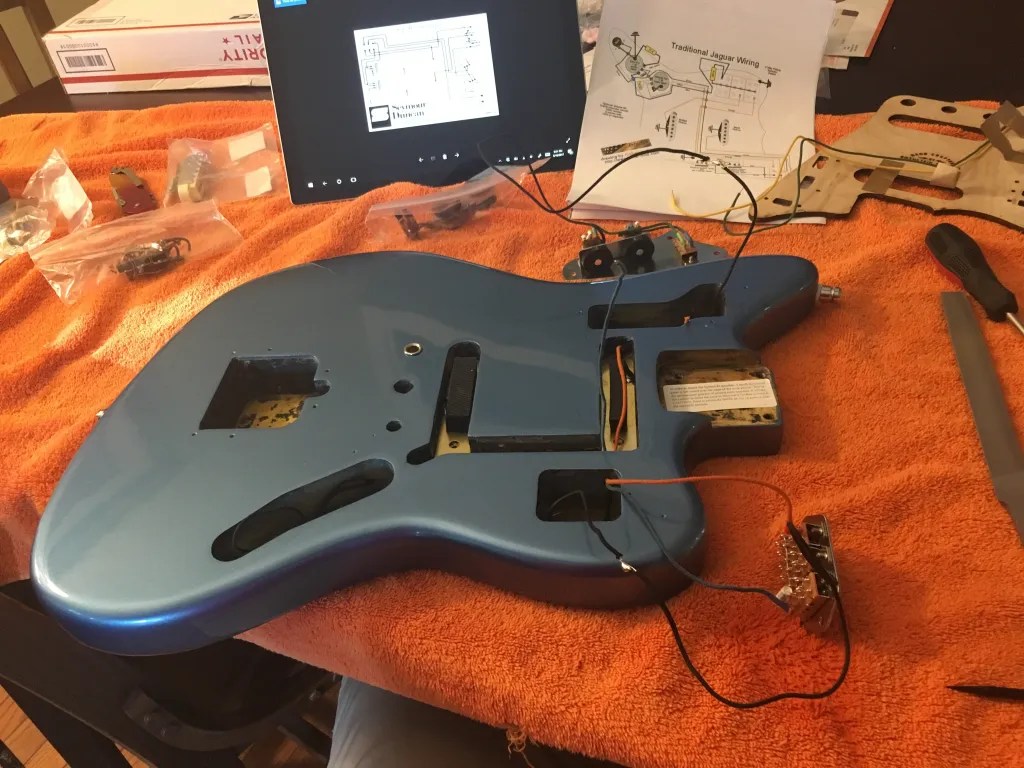
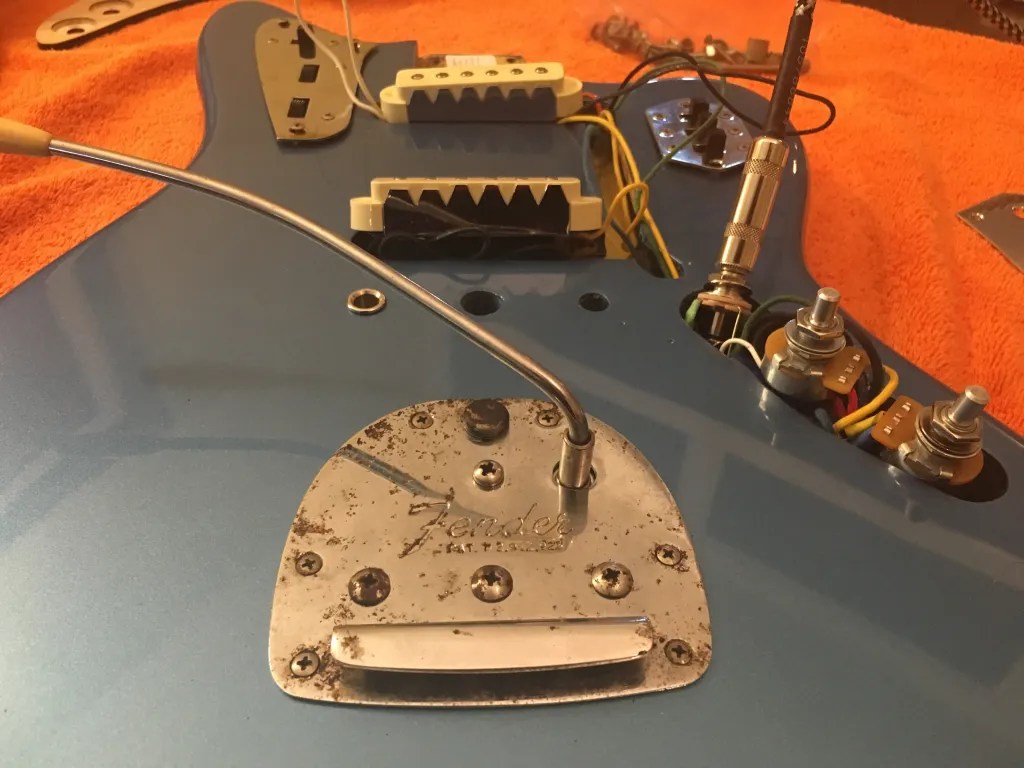
I don’t know about you, but I’m not an electrically inclined person. Wiring diagrams don’t make a lot of sense, even with an engineering degree. It’s just not intuitive for me. I’ve done guitar wiring in the past, modifying my stratocaster and replacing pickups and stuff like that. But I wasn’t prepared for the complexity of the Jaguar’s wiring setup.
You might be able to see a peek of the wiring complexity in the middle picture above. The Jaguar had a pretty weird controls setup. Not only are there the normal volume and tone knobs you’d find on any electric guitar, there’s an entirely additional set of switches that control each pickup individually. You can choose to run the neck pickup, bridge pickup, or both at the same time, not to mention an additional setting that only uses the neck pickup in a specific mode called the “rhythm circuit” which actually makes the guitar sound like it’s being strummed underwater rather than playing a rhythm part. It’s funky and not too useful in actual music but still pretty neat.
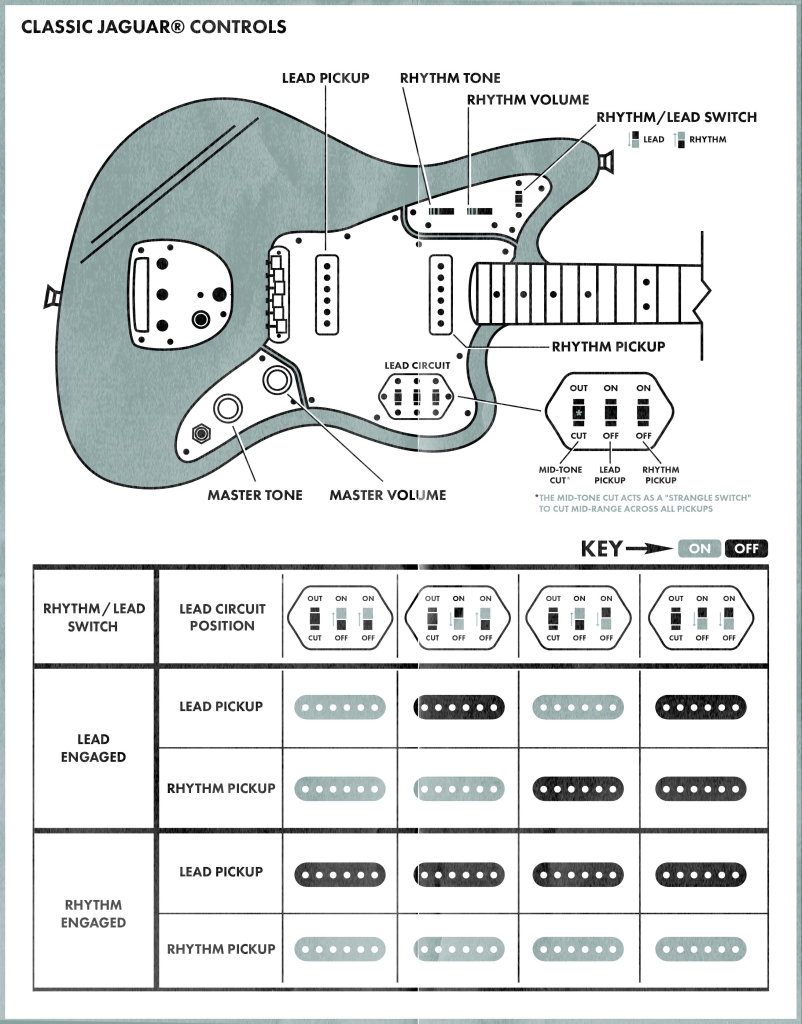 Jaguar controls setup via Fender.com
Fortunately, I found a mostly prewired kit. I know, that’s anticlimactic, but trust me, it was still plenty hard enough to solder the connections together with my clumsy hands.
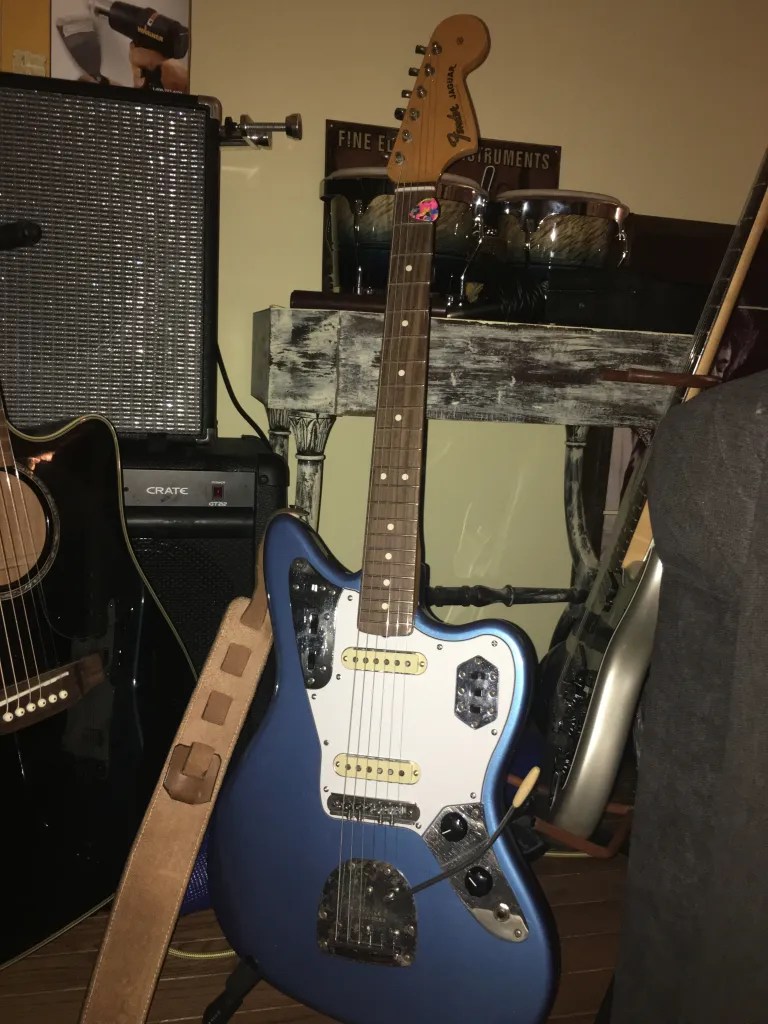
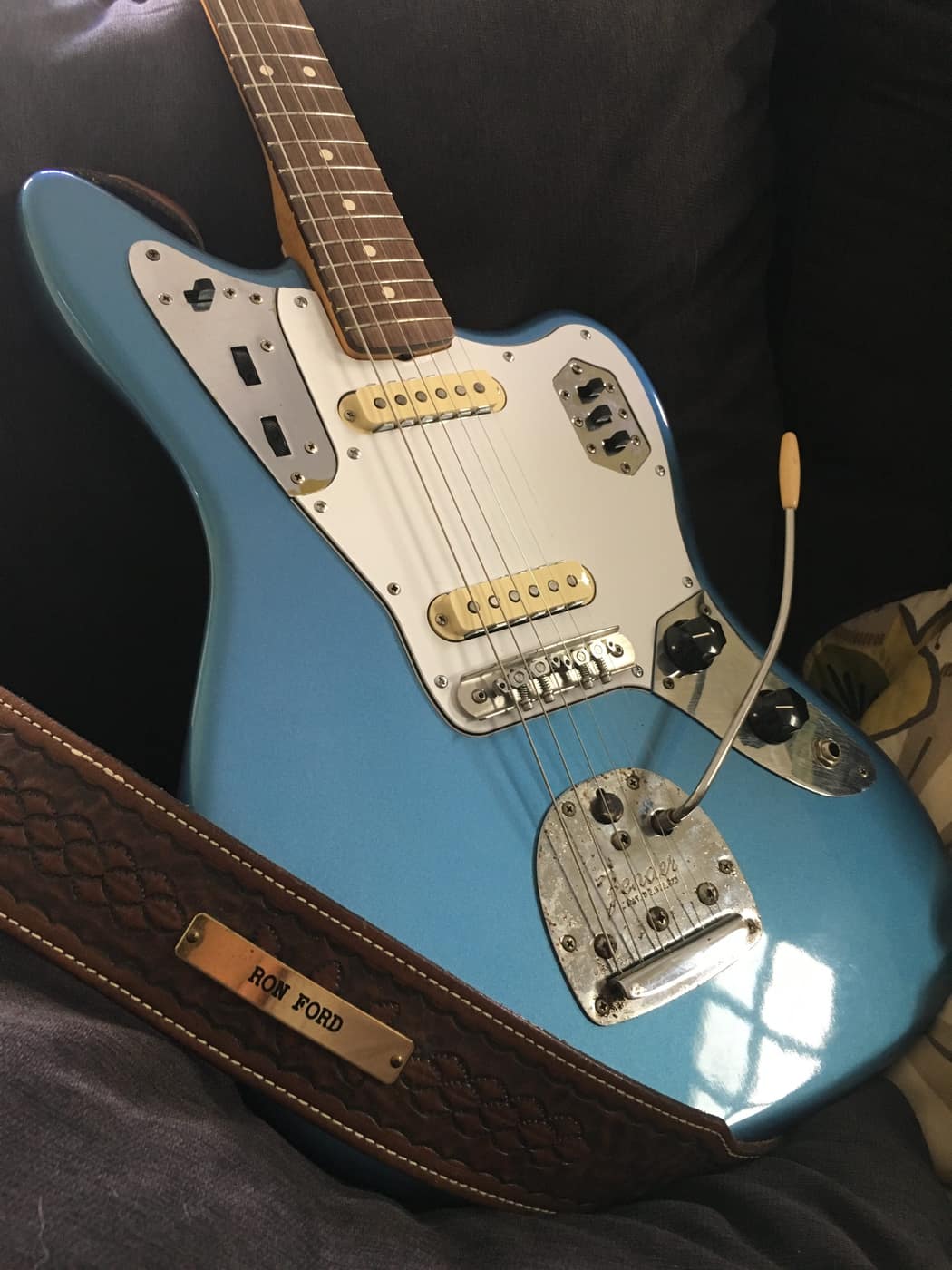
But in the end, the Jaguar was revived! It sounds great, especially playing surf music or some Frusciante-era Chili Peppers. Plus just look at this thing…